2008-10-24

Eight legged freaks


It's almost halloween, so how 'bout some scary biology curiosities? At least it's scary if you have arachnophobia, in other words if you're afraid of spiders (which I'm not...I'm only afraid of things that has no limbs and no face and dwell this earth a couple of centimetres under our feet...yep, I'm afraid of worms!).

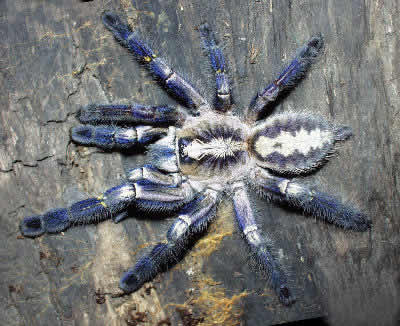
Spiders are kind of cute. They have eight legs, nice eyes (and good vision to, actually), pretty colors and patterns and they may or may not have hair (which isn't hair as in "cuddly", but hair as in "I can sense the worlds movement through sensory systems you humans never could imagine").

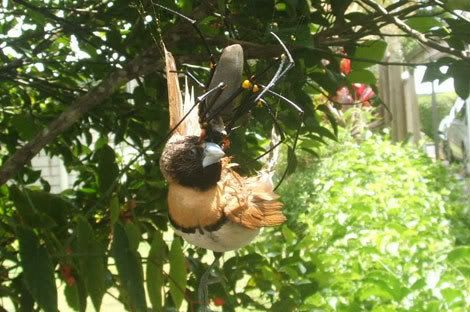
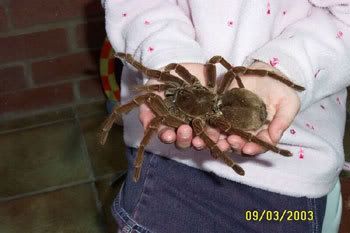
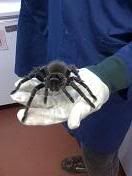
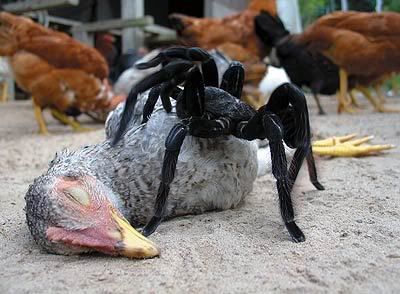
Still, I can see why some of you are frightened whenever you come across an arachnid. They could bite you (which worms usually don't do, unless they're disgusting leeches!) with or without poison; they could move rapidly and unpredictable; they can climb up in any possible environment; you can come across them when you least expect it and they could be huuuge. And they can catch animals way bigger than themselves. They can even eat birds and sometimes, if we're lucky, there's a human with a camera to take some pictures so that we can be facinated that others than ourselves likes to eat some chicken now and then.


It's not really that common
but it seems like they used to be munch frequently on feather delicacies during what one might refer to as "the golden age of mygalomorph spiders".


Sources:

2008-10-15

Eye see you


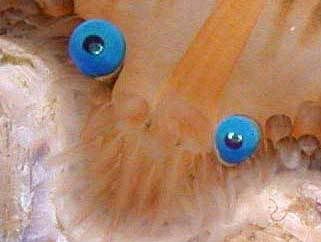
I've never really considered that molluscs could percive the world in a highly sophisticated manner. Well, some actually do. And I should not really be that surprised, but since I'm a human I naturally assume that we are the measure of all things seen as life and that a "simple" little oceanic being would not have senses in the same class as our own...

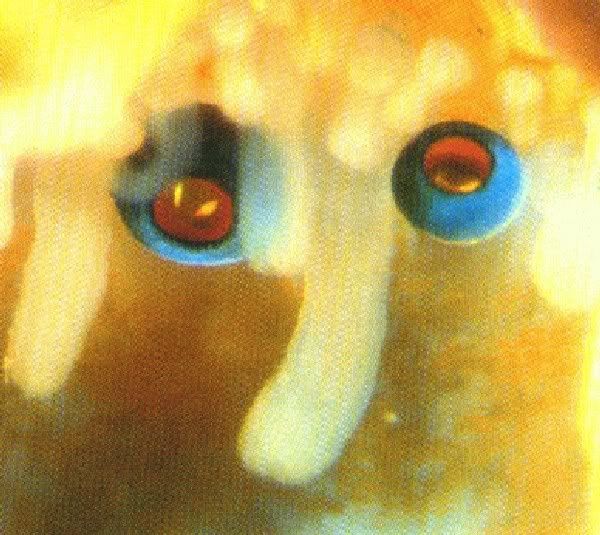
Here's some close-up shots at a clam (Aequipecten irradians) with it's characteristic blueberry-like eyes. Have no time to dig up any dirt about these sensory organs but I trust that you're all familliar with the wonders of google.com!


Image sources:
http://www.augsburg.edu/biology/photoofmonth/scallop-eyes-close.jpg
http://www.eyedesignbook.com/ch3/fig3-05aBG.jpg
http://www.augsburg.edu/biology/photoofmonth/scallop-eyes-menacing-close.jpg

2008-10-08

You fill up my senses

I'm taking an advanced course at the moment, named "Sensory ecology". It's not really my cup of tea, since I'm usually drawn to genes and molecular biology stuff but there are some highlights. Hot shot professors from all over the world have flewn over to Lund just to give us 50 PhD students (also from all over the world) a 2 h lecture about their topic. And we have ca 3 lectures per day in two weeks, which of course makes the speakers want to stand out from the other lecturers by telling us about behaviours and characteristics in nature that deviates from what we, as humans, would like to precieve as normal.

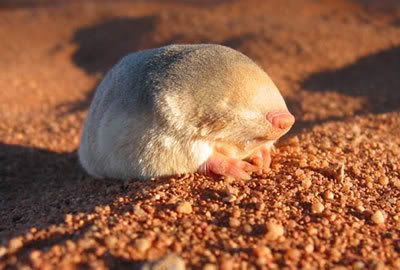
Image revised from http://www.nadeet.org/pics/newsletter/goldenMole.jpg

Today, one of the topics where the golden mole of Africa. This is a cute little guy, but it has such bad eye sight that evolution have allowed the skin to cover the eyes completely, which only allows it to distinguish light from dark. And it doesn't like it light, so as soon as the sun rises, the golden mole burrows itself deep down in the sand. Instead of relying on vision, these creatures dwell the Namibian desert during the night, searching for insects to eat. To be able to locate it's prey (that's only present on small grass humps in the sand, which in turn is only present here and there in the desert), they have an enormous malleus (that thing we have in our ears, banging at the ear drum when a sound wave causes it to vibrate) specialized for low frequency sounds. To detect the insects faaar away, the golden mole combine "head dipping" and "sand swimming", which allows it to detect things we wouldn't even hear if we had the insect in our ear canals. Marvelous!

2008-09-29

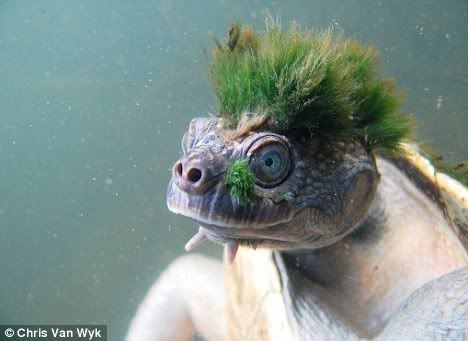
Algea-wigs are back in style

What was she for halloween; the punk-iest turtle you've ever seen.


More pictures of this pretty turtle can be found here!

2008-09-28

Enjoy the silence


I've neglected this blog thingy for a while. Actually, I've not had much time to spend surfing around the allmighty internet, so that's probably the reason behind my lack of inspiration. And my new grown-up era has taken it's time too! I've been out in the field collecting caddisfly larvae and pupae for my first project, followed by rearing in our lab until the adults emerge. Then I've isolated their DNA, and what's next is kind of a secret...

Either way, I thought this might make some of your face muscles twitch. It concerns a phenomenon atleast I thought was mainly human - necrophilia. Well, it's not. For a couple of years ago, the Ig Nobel awards (the Nobel Prize spoof that celebrates bizarre and apparently pointless science) went to a Dr Moeliker who authored the paper
The First Case of Homosexual Necrophilia in the Mallard, Anas platyrhynchos. Sounds to good to be true. Appearently, this guy was at his office when he heard a bang outside the window. When looking out, he saw a mallard duck raping another dead member of the same species. And it kept on for 75 minutes (!) until Moeliker stopped the whole scenario. The destiny of the unfortunate duck was probably a result of ‘Attempted Rape Flight". Ah, nature - it always keeps me enchanted.

Sources
:
http://www.nmr.nl/nmr/pages/showPage.do?itemid=1930&instanceid=16 http://www.timesonline.co.uk/tol/news/uk/article1165607.ece

2008-09-06

It's evolution, baby

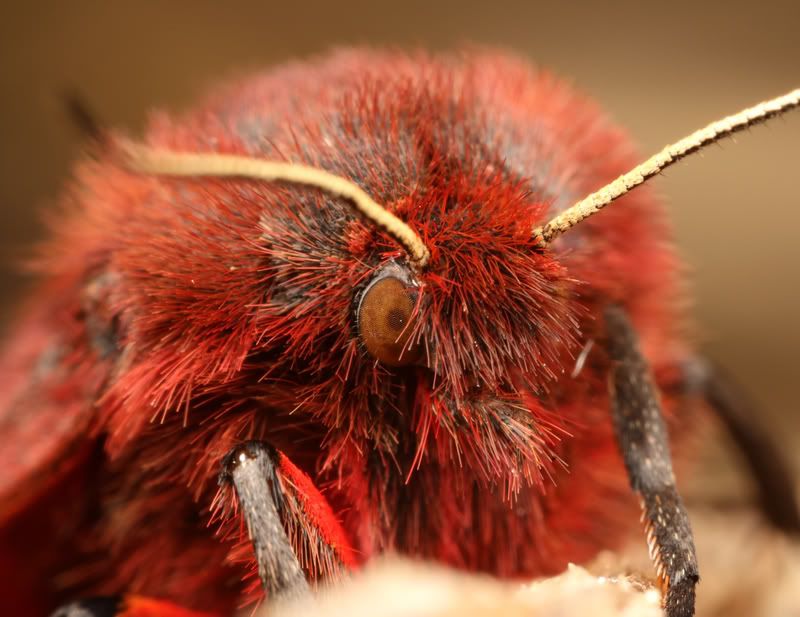
Image revised from http://photography-on-the.net/forum/showthread.php?t=500821

Top news from Nature.com here! For me, this is exciting since it is a very good example of how the evolutionary forces can work. It concerns the tiger moths, which are rejected of a number of predatory species even though they'd probably make a good addition in terms of nutients. Some time ago, it was discovered that some tiger moths produces ultrasonic sounds. Now, this sound is also used by bats, which otherwise likes to eat other individuals of the Lepidoptera. But this sound it is not used to locate the moths. Instead, its used to ward them off, since the bats precive the sounds as toxicity signals (and the tiger moths don't really taste good so if the bat would take a chunk, he'd probably leave it directly which in turn leaves no gain for either the moth or the bat). Tiger moths that are around during summer, when bats are a major threat, uses this as a good way of avoiding becoming dinner. However, some other types emerges when it's springtime and the bats aren't as active. Then, there are other greedy eyes in the environment, such as birds. To cope with this other type of predator, these tiger moths rely on bright coloring to send of some statements to the birds that there's no use in eating them since they would taste unpleasant. Visual signals is also used during the summer, but mainly in day active moths since the daylight makes colors more efficiant. SO, what's cool about this is that two different predators and different light-settings have led to the divergence different antipredator defences within the same species. Like X-men, but for real.

Sources:
http://www.nature.com/nature/journal/v455/n7209/edsumm/e080904-11.html
http://www.nature.com/nature/journal/v455/n7209/full/nature07087.html

2008-09-04

When three become one


I'm monogamous to the extreme, and have never understood why some people likes to wrestle around with several mates at the same time. I suppose I'm what many of my colleagues in the world of evolutionary biology would refer to as a "choosy female". I want one mate and when I find him (which I already have, but that's another theme) all my focus and energy will be on him. Of course, this is not a view that I share with many organisms. The animal kingdom is filled with mating behaviour that, if these manners would ever occur in humans, would make all our religious leaders and puritanists have multiple heart attacks.

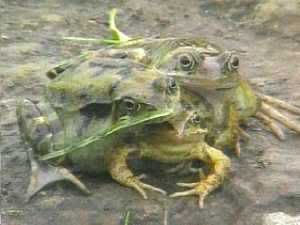
For example, male toads mount the female from behind and then fertilizes her eggs externally. This is called amplexus. Since there are many males that have aburning desire to produce some offspring, a single female can be mounted by several males at once (called "multiple amplexus") and different eggs can be fertilized by different males (and the female may actually drown due to the heavy load but I suppose the males are to aroused to care). Multiple amplexus is presumably the reason behind the now-and-then reports of frogs with three heads. It's not one frog with three heads; its three frogs strongly indulging in corpulation so that it looks like one being. True love, perhaps...

Sources: