skip to main |
skip to sidebar
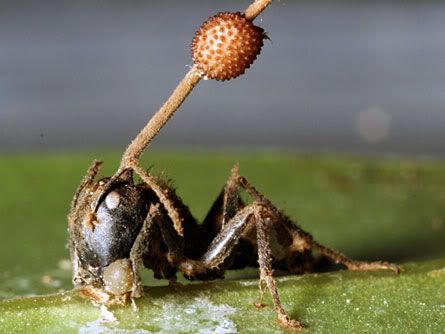
 Zombie ant!!! Lost in fungi-land...
Image taken from http://www.sciencenews.org/view/download/id/46186/name/Death_grip_
Source
The Life of a Dead Ant: The Expression of an adaptive Extended Phenotype.
Sandra B. Andersen, Sylvia Gerritsma, Kalsum M. Yusah, David Mayntz, Nigel L. Hywel‐Jones, Johan Billen, Jacobus J. Boomsma, and David P. Hughes
The American Naturalist. Volume 174, Issue 3, Page 424–433, Sep 2009
I'll write something more substantial sooooon but until then, have a look at this:

Image taken from http://www.davincium.com/
If you're like me and have a soft spot for Neanderthals and their dim-lit fate, Scientific American has a nice online-article for you to read. At least I liked it, although there's always a big spoon of assumptions and fantasy-thoughts fed to you regarding what once was.
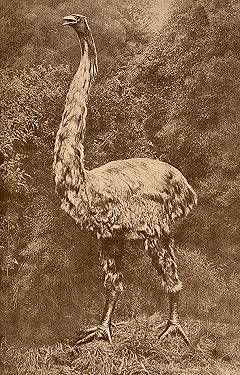
Continuing with a sort of "endangered species"-theme, I thought I'd write a few lines about a truly magnificent species that another species (*harr harr* Homo sapiens) hunted away from existing to extinction - the Giant Moa (Dinornis). I may be late but I'd never heard about it until today when I red that some researchers had managed to recover DNA from the 2500 year old feathers of this bird. They were able to connect four known Moa species to the DNA samples and thus, were able to draw some conclusions over how these four species looked like. And even better, by comparing the Moa feathers to the still-alive-and-well red crowned parakeet's feathers (but feathers of the same age as the Moa feathers) they could conclude that the colours had not faded or changed.

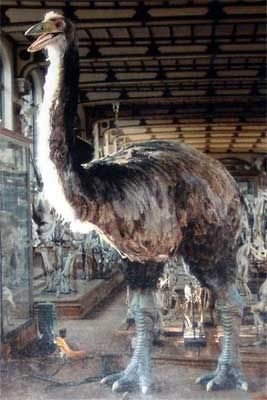
Reconstructed Giant Moa on some New Zeeland museum.
Image taken from http://www.fotothing.com/photos/9e8/9e818de8b2c96bbd935711688b484789_31c.jpg
Anyway, I wanted to read more about the Giant Moa so with a single google step I learned that this could have been the largest bird that ever lived, reaching up to 2.5 m and weighing 230-240 kg! That's one big chicken McNugget. They seemed to live a grazing lifestyle on New Zeeland until the arrival of the Maori and later, colonists who wanted to eat it, and also due to the ever growing agricultural landscapes destroing the Moa's natural habitat. By 1500, it was gone forever. Shame on us!
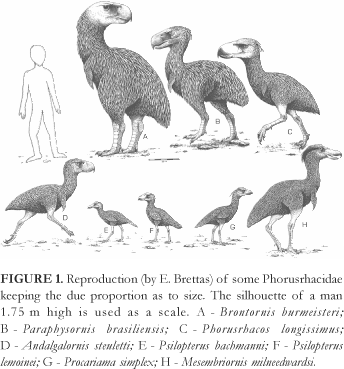
Even more shame on us; here's some more long gone gigant birdies that we'll never be able to see again:

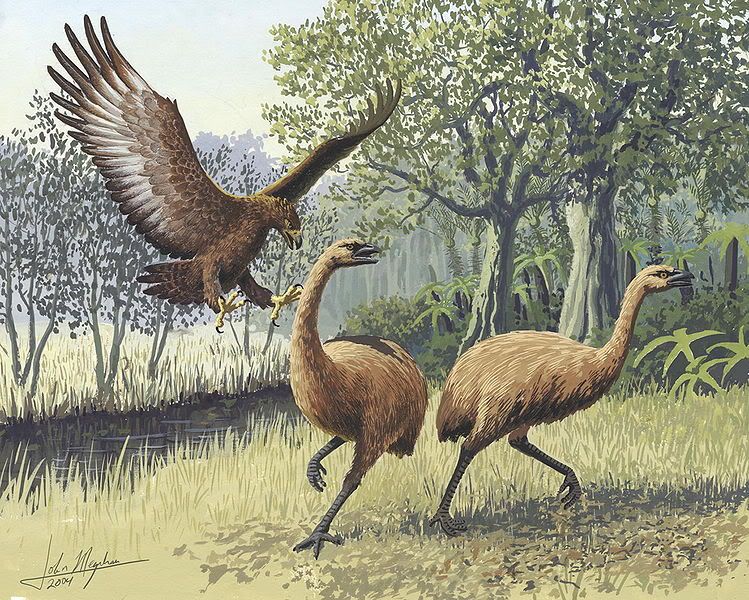
Haast's eagle, chasing some giant Moas (now you do the size math)
Source:
Nicolas J. Rawlence, Jamie R. Wood, Kyle N. Armstrongand Alan Cooper. DNA content and distribution in ancient feathers and potential to reconstruct the plumage of extinct avian taxa. Proceedings of the Royal Society of London Series B., June 30, 2009 DOI: 10.1098/rspb.2009.0755
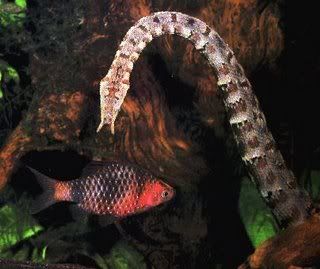
It's tempting to believe that you have to be an intelligent being to have a highly sophisticated way of catching your prey. I don't much about the average IQ level in snakes but I'm pretty sure that they don't have any members in MENSA just yet. Still, this is a group of animals having exquisite methods of killing. You all know about venom and such, but have you ever heard about fooling your prey to swim into your mouth? Because that's exactly what this tentacled snake (Erpeton tentaculatum) does. When a nice little fishy passes by, E. tentaculatum positions itself in a motionless J-form behind it and sends of sound waves from the middle of its body. "Hey, what's that noise?" the fish wonders, and turns instinctively towards the other direction and suprise! There's the snakes mouth, wide open and filled with gluttonous desires strong enough to wipe out the fish from this world. Seems like a sirty trick to me, but nature shows no mercy when it comes to food.
Check out the movie found at this link for a glimpse of the snake in work.
Source: Tentacled snakes turn C-starts to their advantage and predict future prey behavior Kenneth C. Catania PNAS published online before print June 19, 2009, doi:10.1073/pnas. 0905183106

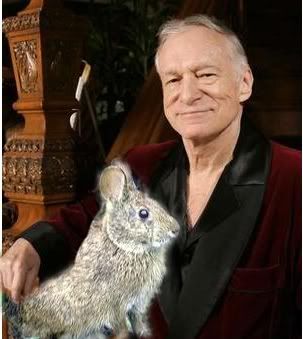
So if I say "Hugh Hefner", you probably have loads of negatively or patronizing thoughts in the back of your head. He's not really been associated to saving the world, or working free in soup kitchens for the homeless. Well, just like any other being, he probably has things that are good about him in a social/environmental context and things that are bad. I just read a good thing though, because he's just donated money (and given his name) to a bunny species, Sylvilagus palustris hefneri, that's on the verge of extintion.
I may be naive, but I bet that's better for our worlds flora and fauna than looking in magazines and get upset over "the rich and the famous" and get satisfied by how good moral you have compared to these characters. No species saved there! But then again, I also bet that the (in)famous house of Mr Hefner is quite an environmental fiend in terms of energy waste and such. Either way, we may be able to keep another species thanks to his donation, which is neat in many ways.
Sources:
http://www.newscientist.com/blogs/shortsharpscience/2009/06/playboy-bunnies-bouncing-back.html
http://blogs.discovery.com/news_animal/2009/06/playboy-bunnies-close-to-extinction.html

Image taken from http://rachelannmason.com/Images/thumbnailimages/bigger%20images/habsburg%20jaw/hemisphere/ambassadors/chiefs/carlos/carlos.jpg
But I've got something exciting to write about now (at least exciting if you're me). It's a combination of history and biology, namely royal inbreeding leading to the extinction of the spanish Habsburg dynasty. These guys saw it as the ultimate marriage to get to say "I do" at the altar next to an uncle, a niece or a first-cousin. Of course, this genetic conservatism came with some setbacks. Instead of keeping it in the family (whatever it may be...royal strengh, blue blood, strange eating habits, and so on and so forth) this just brought up all those recessive traits that the founders of the dynasty might have carried around in their royal genome. So the Habsburgers included a few characters that got noteworthy names such as Joanna the mad, as well as yielding physical features such as a enlarged lower jaw.
The inbreeding came to its peak with Charles II of Spain. He was the son of the Habsburgers Mariana of Austria and Philip IV of Spain. These parents were not only related, they were uncle and niece, which meant that his grandmother was also his aunt. This might have been ok if not all other relatives (his parents, grandparents and backwards) were somewhat the result of interbreeding. A study was recently published showing that 24.5% of Charles II genome could have been made up by identical genes, which is basically what you can expect from a brother-sister interbreeding. Because of this genetic uniformity, Charles was mentally disabled as well as disfigured. He had ha hard time chewing (most likely due to the same condition that the earlier mentioned enlarged jaw) and some notes states that his tounge was so large that it was hard to understand what he was saying, and he frequently droowled. He didn't learn to speak until the age of four and he couldn't walk until he was about eight years old. Not what you'd expect of a godgiven royal dynasty. In addition, one of the many duties of being a king is to produce an heir, something that Charles never was able to due even though he tried with two wives, most likely due to impotence.
In short - if you ever had a delirious idea about your family's excellence in terms of heritability, then you should go wash your face with something cold and go for an unrelated spouse. Or else you may bring out genetic traits in your grandkids that will not look so good for the record.
Source:
http://www.plosone.org/article/info%3Adoi%2F10.1371%2Fjournal.pone.0005174
http://sciencenow.sciencemag.org/science-shots/