skip to main |
skip to sidebar
You're enjoying a good nights sleep when suddenly you hear a weird scratching sound on your wall. When you turn on the light you see this:
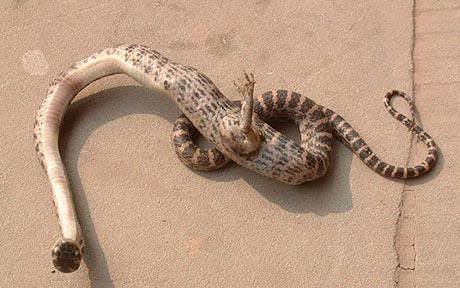
Yup, it's a snake with a leg. This awakening would certainly be something to tell your grandkids about...
The story can be found here.
I've never understood why so many biology-people fancy ornithology. I actully think it's one of the most gasp-altering parts of biology (not a popular thing to admit in our building). But if the Maori man-eating bird legend would be true, which now seems to be comfirmed (at least somewhat) I could reconsider my statement.
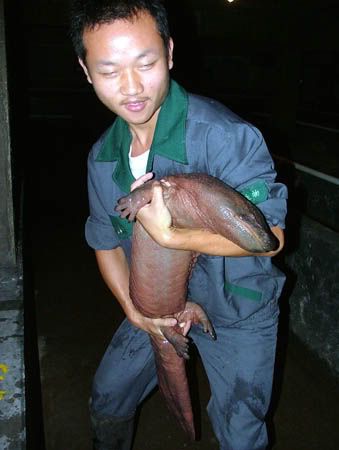
Did you know that there were such a thing as Giant salamanders? I certainley did not. I mean, I haven't really thought about salamanders that much during my 26 years here, apart from a summer when I was 9 and a friend collected small little slimey ones in a wetland close to my hometown. So I've assumed that salamanders are small, perhaps with some variation up to Gecko-lizard sizes but not huuuge.
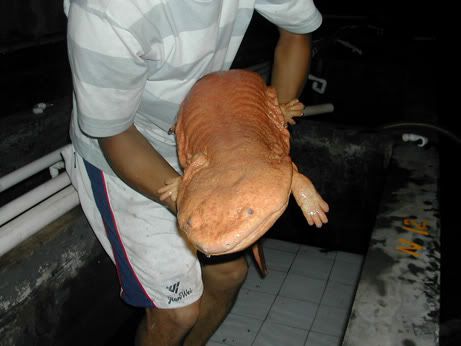
So therefore I was extremely facinated, and somewhat horrified in a way that H.P. Lovecraft would explain as "unexplainable", when I surfed upon this image:

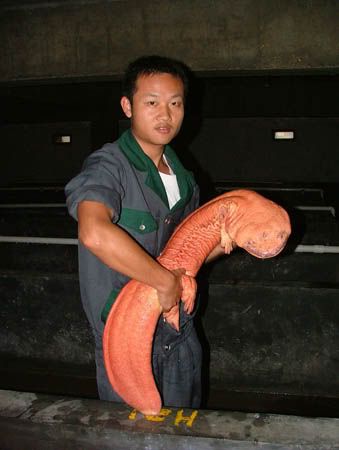
It's enormous! Not just big but enormous! And there's actually a few variants; one species in China one in Japan, and one in the US. The Chinese salamander can reach 1.8 metres. That's just 8 cm longer than I am. Creepy (yeah, I know - Protagoras "Homo mensura" definitley holds when we tag animals as "huge", "ugly" and so on but I believe that no non-humans will ever read this blog and therefore I take the liberty to call other beings whatever adjective that I want!). They all have poor vision and mainly hunts during the night, when they go for fish, molluscs, worms and other yummy things. I thought that I would find some statement that they are friendly creatures with no known conflicts with humans but they can actually bite and inflict quite a bit of pain. If this is a rare event or if it's something that can happen whenever you swim in their territories it doesn't say. However, I will definitely not dip my toes in their waters...
Of course, all things large enough to threaten the community of Homo sapiens are in a risk of being pushed away. Sadly, this is also the case for the Giant salamanders. I bet that in 100 years or less, we will be the only creature (except for domesticated animals) that are allowed to be more than 1.4 meters long. Just wait and see.
Sources:
http://en.wikipedia.org/wiki/Hellbender
http://en.wikipedia.org/wiki/Giant_salamander
http://en.wikipedia.org/wiki/Chinese_giant_salamander
http://en.wikipedia.org/wiki/Japanese_giant_salamander
I don't know how many of my followers (ha ha) of this blog (ha ha) that is actually practicing molecular biology. But since I know of at least one, I'll post this eye-opener: Bitezize Bio.org!!! It's the best darn discovery of done since I first entered the university area. I'm serious. Just surf in, read the articles, tips, links, everything and you'll get more enlightened in a single day than you've been the latest year.

Image: Péter Estók
There's a video for you at New Scientist! I can't help it, but this story makes me smile because people tend to view these "cute, little birds" as nice and vunerable creatures, while other birds such as the Rook (Corvus frugilegus) is regarded as a mean scavenger not worthy of your bread crumbs. I will definitely keep this story in mind whenever this topic comes up....
 Image taken (and edited) from http://www.dailymail.co.uk/news/article-1211554/New-frog-rat-species-discovered-Papua-New-Guinea.html
http://blogs.nature.com/news/thegreatbeyond/2009/09/giant_rat_found_in_extinct_vol.html
http://www.dailymail.co.uk/news/article-1211554/New-frog-rat-species-discovered-Papua-New-Guinea.html
http://www.guardian.co.uk/environment/2009/sep/07/discovery-species-papua-new-guinea
http://news.bbc.co.uk/earth/hi/earth_news/newsid_8215000/8215144.stm
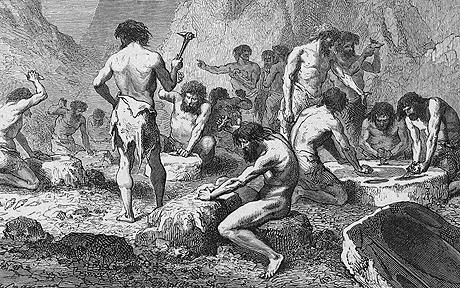
In case you ever have had a sleepless night pondering about whether or not the first farmers in Central Europe were homies with the hunter-gatherers that's been roaming these parts of the world before them, then a there's a report in Science to give you some answers. By comparing mitochondrial DNA sequences from skeletal remains, as well as to modern Europeans they compared so called haplotypes - a pice of a DNA sequence that can be present in two or more versions. For instance, one individual might carry a sequence as TTGCCA while the other has a TTCCCA. The nice thing is that thanks to reproduction and time (and a lot of other factors that I won't write about now), individuals within a population may have more of one of the haplotypes than the other, while in another population the situation can be the opposite.
And this is the case for these mitochondrial haplotypes that the researches looked at. One, that's simply called U, was dominating the pre-farming populations, while modern Europeans carry another version called N1a. The latter was found to be present mainly in the early farmers and therefore, the researchers conclude that no, the early farmers seemed not to interbreed with the hunter-gatherers, because then the Europeans today ought to have a blend of both the U and N1a haplotypes. And no genetic exchange of women occurred, they state (why now that should be a suprise). They also say that we who live in Europe today (and humanoid earthlings with european background, I assume) have very little left of these first inhabitants.
If you want to read a longer and better overview of the story, there's another blog that's doing an excellent job about it. You will find it here (at the cool blog dienekes.blogspot.com). Either way, what I find most facinating with this story is that all us million people calling us Europeans today seems to walk around with similar haplotypes, which in turn means that we are decendants from a small group of ancestors that lived came here not that long ago. That's like having a great-great-great-ans-so-on grandmother that was an awsome geographical entrepreneur!